Research

Ongoing and submission-ready research projects.

Ongoing

Genipin-Crosslinked Modified Silk Fibroin–Chitosan Hybrid Hydrogel for Synergistic Dual Drug Delivery and Accelerated Wound Healing

Wound healing is often delayed by bacterial infection, prolonged inflammation, and oxidative stress, while conventional dressings offer little more than physical protection. This project aims to develop a multifunctional hydrogel dressing that delivers therapeutic agents in a controlled, localized manner while supporting tissue regeneration.

Silk fibroin is first modified by alkali treatment followed by Atom Transfer Radical Polymerization (ATRP), grafting HEMA to improve hydrophilicity, water uptake, and mechanical stability, and DMAEMA to introduce pH-responsive amine groups that enhance drug loading and antibacterial activity. The modified silk fibroin is combined with chitosan, which contributes intrinsic antibacterial, hemostatic, and bioadhesive properties, and crosslinked with genipin, a natural crosslinker with low cytotoxicity.

The hydrogel will be loaded with two drugs: ciprofloxacin for broad-spectrum antibacterial activity, and naringenin to reduce inflammation and oxidative stress and promote collagen deposition. This dual-drug system is expected to provide sustained release, stronger antibacterial action, and accelerated wound healing.
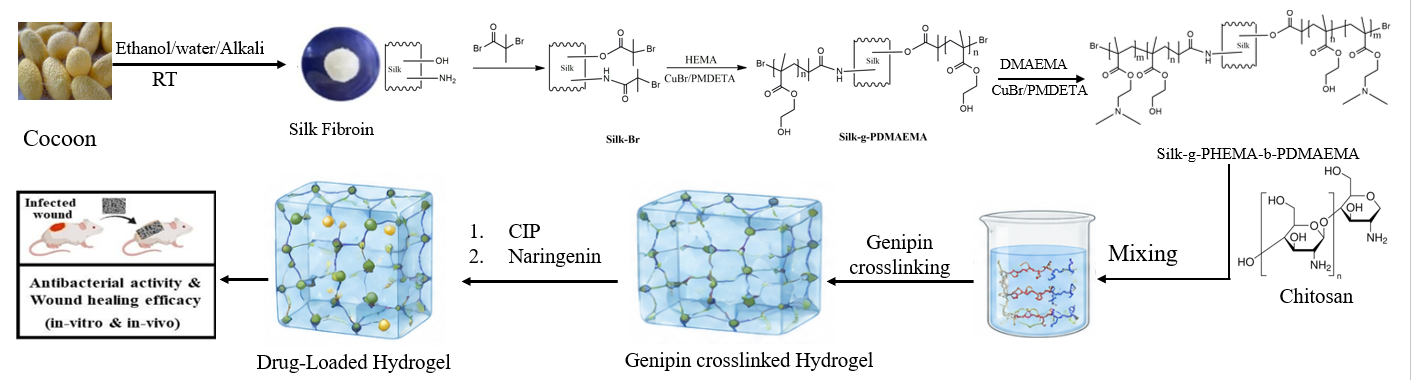
Research schematic showing silk fibroin modification, chitosan mixing, genipin crosslinking, ciprofloxacin and naringenin loading, and the intended wound-healing application.
Project 1 research schematic extracted from Research section.docx.

Sericin-g-(PMMA-b-PDMAEMA)/PVA Hydrogel Loaded with Centella asiatica Extract for Wound Dressings

Delayed wound healing caused by infection, prolonged inflammation, and oxidative stress remains a major clinical challenge, and conventional dressings offer little beyond physical protection. This project aims to develop a bioactive hydrogel wound dressing from sericin, a protein discarded during silk degumming, combined with a plant-derived therapeutic extract.

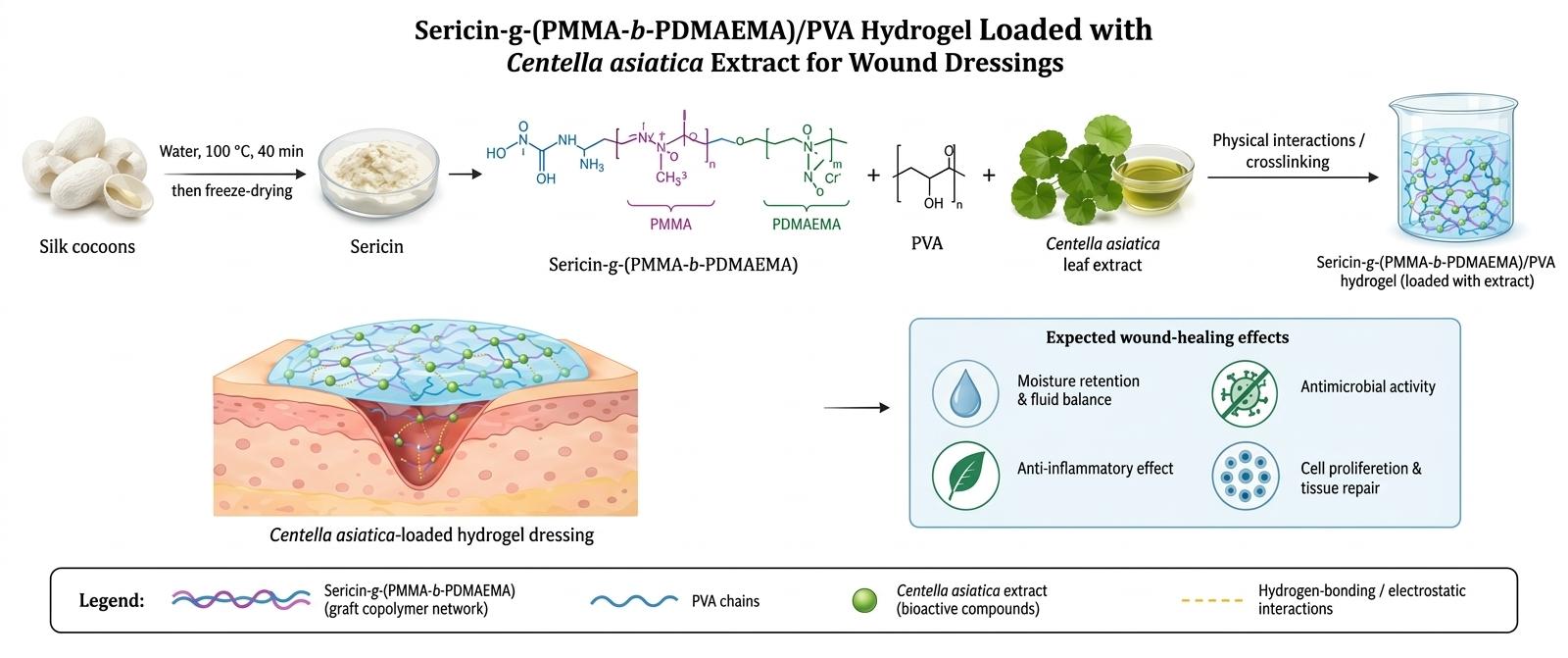
Sericin is modified by Atom Transfer Radical Polymerization (ATRP) to synthesize a sericin-g-(PMMA-b-PDMAEMA) graft-block copolymer. The PMMA segment improves mechanical stability, while the PDMAEMA block introduces tertiary amine groups that enhance extract loading and antibacterial performance. The copolymer is blended with poly(vinyl alcohol) (PVA), which contributes flexibility, mechanical strength, and water retention, to form a hybrid hydrogel stabilized by physical crosslinking.

The hydrogel is loaded with Centella asiatica (thankuni) leaf extract, a traditional medicinal plant known for promoting collagen synthesis, fibroblast proliferation, and tissue regeneration, along with antioxidant and anti-inflammatory activity. This system is expected to provide sustained release, antibacterial activity, and a moist healing environment suitable for wound dressing applications.

Research schematic showing sericin extraction, ATRP graft-block copolymer formation, PVA and Centella asiatica extract incorporation, and expected wound-healing effects.
Project 2 research schematic extracted from Research section.docx.

Submission ready

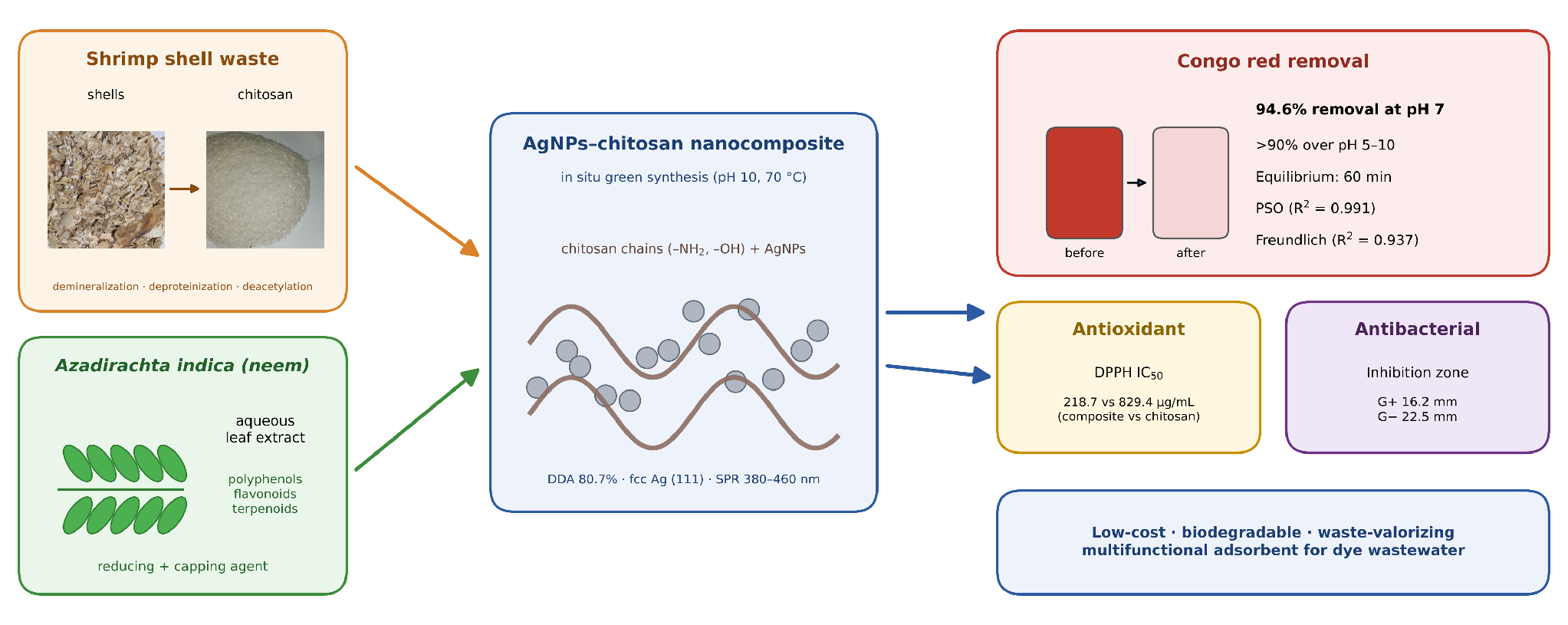
Green Synthesis of Chitosan-AgNPs Nanocomposite using Azadirachta indica Aqueous Leaf Extract for Removal of Congo Red from Wastewater

The discharge of azo dyes such as Congo red (CR) into water bodies poses serious environmental and health risks, calling for low-cost and sustainable treatment materials. In this study, chitosan was extracted from shrimp shell waste and used as a matrix for the in situ green synthesis of silver nanoparticles (AgNPs) using aqueous Azadirachta indica (neem) leaf extract as the reducing and capping agent. The extracted chitosan had a degree of deacetylation of 80.70% and a viscosity-average molecular weight of ~371 kDa. The formation of the AgNPs–chitosan nanocomposite was confirmed by UV–Vis spectroscopy (surface plasmon resonance band at 380–460 nm), FTIR, XRD (face-centered cubic Ag) and SEM–EDX analyses. In batch experiments, the nanocomposite removed up to 94.6% of CR at pH 7.0 and maintained >90% removal over pH 5–10, with an optimum dose of 0.6 g/L and an equilibrium time of 60 min. The adsorption followed the pseudo-second-order kinetic model (R² = 0.991) and the Freundlich isotherm model (R² = 0.937), indicating favorable adsorption on a heterogeneous surface. The nanocomposite also exhibited higher DPPH radical scavenging activity (IC₅₀ = 218.69 µg/mL) than chitosan (IC₅₀ = 829.40 µg/mL), as well as antibacterial activity against Staphylococcus succinus (16.2 mm) and Xanthomonas campestris (22.5 mm). These results demonstrate that the green AgNPs–chitosan nanocomposite is a promising multifunctional and biodegradable adsorbent for the treatment of dye-contaminated wastewater.

Research infographic showing shrimp-shell chitosan, neem-mediated silver nanoparticle synthesis, Congo red removal, antioxidant activity, and antibacterial activity.
Project 3 research infographic extracted from Research section.docx.